
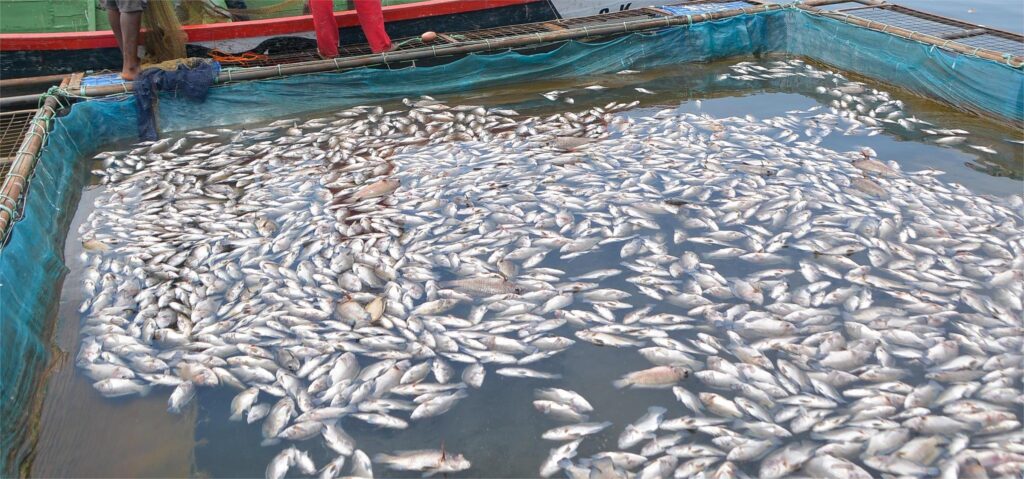
The study surveyed 172 cages across Kenya’s five counties that border Lake Victoria.
by Blue Africa News
A new study by a group of researchers has found that the widespread fish deaths in cages along beaches on the Kenyan side of Lake Victoria, are most likely caused by deteriorating water quality.
Kenya, Uganda, and Tanzania share the Lake Victoria resource – the second largest fresh water body in the world after Lake Superior in North America, with cage fish farming providing nutrition and livelihoods to over 40 million people within the Lake basin.
According to a 2022 report by the Kenya Marine and Fisheries Research Institute (KMFRI) and the Aquaculture Business Development Program (ABDP) titled “Sustainable Community-based cage Aquaculture in Lake Victoria, Kenya,” cage culture has emerged in recent years as a new livelihood in Lake Victoria.
The report stated that the installation of cages in Kenya had expanded significantly from 1,663 in 2016 to 5,242 in 2022, accounting for 21,000 metric tons of fish annually, against the estimated carrying capacity of 109,226 tons per year.
Fish farming is increasing rapidly in Africa, with Egypt the continental leader. Other countries such as Kenya are taking steps toward boosting their fish production capacities but gains have been held back by various issues, including pollution.
By 2021, Egypt had achieved a total fish production of 2.3 million tons across various species, with tilapia alone accounting for more than half of the output.
The Nile River, which counts Lake Victoria as one of its sources, is critical to the North African country’s massive aquaculture industry, with Egypt’s production of Nile tilapia second only to China, globally.
Results of the study by environmental scientists republished in the Conversation revealed that Lake Victoria’s water-quality problems are caused by low oxygen levels, pollution and harmful algal blooms.
Algal blooms, the researchers said, refer to the rapid growth and subsequent decomposition of algae, leading to the release of toxins and rapid drops in dissolved oxygen levels.
“These water quality problems create openings for infectious bacteria to thrive,” they said.
They suggested stronger disease reporting systems to enable a prompt response from industry authorities, improved diagnostics to determine the cause of fish mortalities and clear guidelines for antimicrobial use among farmers as some of the ways of addressing the challenge.
Without the interventions, they warned that the sustainability of a rapidly growing industry and the food security of millions in East Africa, remains at risk.
The study, first published in July, 2025 by Journal of Fish Diseases surveyed 172 cages across Kenya’s five counties that border Lake Victoria (Busia, Siaya, Kisumu, Homa Bay and Migori).
Michael Otieno Nyaguti, an environmentalist in charge of the Magnum Environmental Network – a Kisumu based environmental organisation agreed with the research findings, especially on pollution.
“There is a lot of pollution that is going into the Lake,” Nyaguti told Blue Africa News in a call, blaming factories around the Lake for releasing waste water into the water body.
He added that even though domestic polluters continue to play a role in contamination through throwing litter, including diapers and releasing raw sewer into the waterway, “but not contributing to the extent of being able to kill the fish in the Lake and change the colour the way we have seen it.”
As a remedy, he called on both the national and county governments in Kenya to ensure that factories bordering Lake Victoria operate within the law.
“They must treat their waste up to the required standard. It is expensive anyway to treat such waste but the National Environment and Management Authority and the Water Resource Authority must lead in enforcement,” he said.
He also challenged the National Environment Management Authority to publicly share the environmental audits on an annual basis as pertained to factories that operate near the Lake.
In September, massive fish deaths hit farmers in Kenya’s Kisumu County, attributed to an acute shortage of dissolved oxygen in the water, possibly caused by human-induced pollution. Similar incidents occurred in 2022 and 2023, when cage fish farmers lost over Sh880 million.
Oliver Ochieng, Blue Africa News