
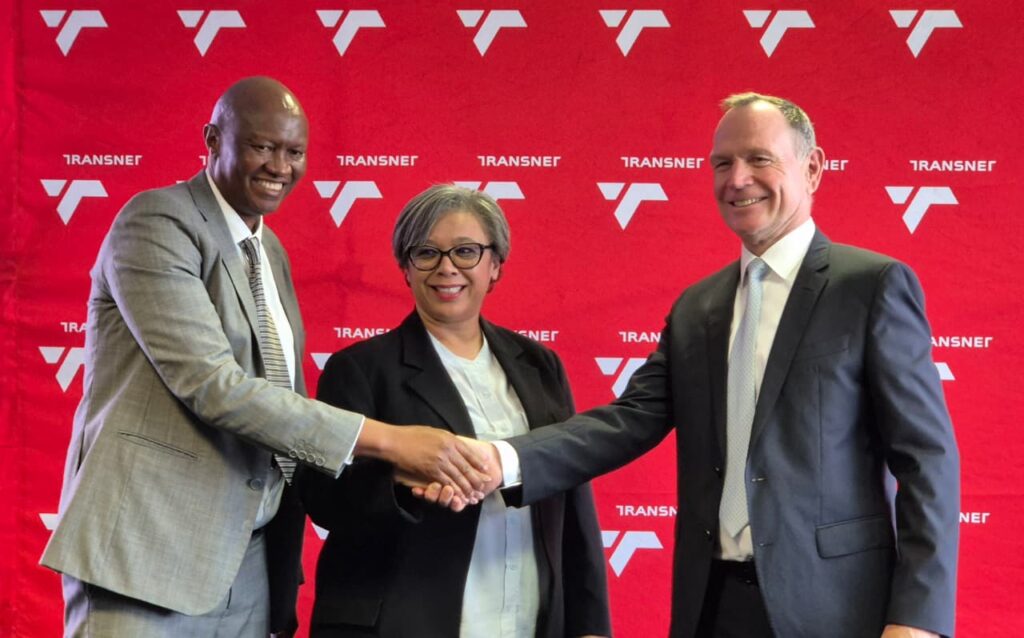
Durban Container Terminal is a pivotal hub for the entire Southern African region, serving trade links to the Far East, Middle East, Australia, South America, North America and Europe and the Transnet-ICTSI deal offers a major boost to regional trade.
by Blue Africa News
South Africa’s state-owned rail, port and pipeline company, Transnet, has inked a 25-year partnership deal with International Container Terminal Services Incorporated (ICTSI) for the development and management of Durban Container Terminal (DCT) Pier 2.
Under the deal, a joint upgrade and development of the terminal between Transnet Port Terminals (TPT) and ICTSI will take effect on January 01, 2026, signaling a huge step in the government of South Africa’s economic reforms agenda, and Transnet’s strategy “to crowd in the private sector into selective and strategically identified areas of the business.”
“Through our deliberate and expansive investment in new equipment across our terminals, the performance of DCT Pier 2 has been on an upwards trajectory,” said Transnet Group Chief Executive, Michelle Phillips in a media statement.
With ICTSI coming in with an investment of R11 billion (approximately US$650 million) Phillips said the expectation is to further propel the crucial terminal to its full potential, stating that private sector participation (PSP) transactions are an important element of their strategy to modernise, expand and improve key assets.
“It is also a big step in our efforts to improve efficiencies across our terminals and transform our ports into world-class hubs,” she added.
“This is consistent with our approach to enhance efficiency and growth through strategic partnerships. Private sector participation in ports has the potential to positively influence efficiencies, export processes and global competitiveness.”
Hans-Ole Madsen, ICTSI’s Senior Vice President said the partnership marks a shared commitment to revitalising South Africa’s maritime infrastructure, and unlocking new opportunities for growth for South Africa and the entire region.
“Pier 2 is a strategic asset for South Africa, critical to trade, jobs, and economic growth. ICTSI is proud to invest in Durban’s future, bringing global expertise and technology to ensure DCT Pier 2 becomes a world-class terminal that benefits the entire region.”
Much was going on in the background, before the agreement was announced on December 10, 2025. In July 2023, Transnet settled on ICTSI as the preferred bidder for the transaction, on the backdrop of a rigorous procurement process.
Through the introduction of new equipment and advanced technology, Transnet says, DCT Pier 2 is expected to increase its capacity from 2 million to 2.8 million twenty-foot equivalent units (TEUs) annually, and improve Gross Crane Moves per Hour (GCH) from 18 to 28 as well as Ship Working Hour (SWH) from 60 to 120.
“These improvements are envisaged to reduce logistics costs and improve service quality, thus broadening market access and attracting new volumes,” the company said.
Durban Container Terminal is situated on the east coast of South Africa. According to the South KwaZulu-Natal Department of Transport, the volume of containers handled at the terminal represents more than 60% of the total number of containers handled at all South African ports.
It is a pivotal hub for the entire Southern African region, serving trade links to the Far East, Middle East, Australia, South America, North America and Europe, while also serving as a transshipment hub for East Africa and Indian Ocean islands.
The agreement with ICTSI stipulates that Transnet will hold a majority shareholding (51%) while the Manila, Philippines headquartered company will hold a 49% stake responsible for operation of the terminal.
ICTSI, a global developer, manager and operator of origin and destination (O&D) ports, operates 34 terminals in 19 countries across six continents, among them Africa, with its partnership agreements covering long-term concessions (25 years on average).
Congestion, equipment failure, and slow turnaround times at South African ports have always been linked to the country’s ports consistently ranking among the least efficient in the world.
The Transnet-ICTSI deal is therefore being seen as the strongest attempt yet to reverse the decline, offering a possible and much needed boost to exports, imports, retail supply chains and manufacturing sectors.
Oliver Ochieng, Blue Africa News