
East African Sea Food is Kenya’s leading exporter of Nile Perch, elevating brand Kenya on the global stage. However, the fishery is under pressure due to declining water quality.
by Blue Africa News
East African Sea Food Limited, a leading exporter of Nile Perch to major European markets, has been a key player in Kenya’s fisheries sector since 1990 and has built a considerable reputation for quality, sustainability and community engagement.
Founded in Nairobi, the company’s management relocated it to Kisumu, a town on the coast of Lake Victoria in Western Kenya in 1994 to cut transportation costs to and from Kenya’s famous Nile Perch breeding ground. It takes over 6 hours to drive from Nairobi to Kisumu, a stretch of over 340 kilometres.
Sebastian Xavier, General Manager of East African Sea Food Limited explained in interview in Kisumu on December 10 that when the company began operating it was in competition with between 10-12 other companies.
Today, the company is the only survivor in the sector. Xavier puts that success down to a laser-like focus on quality.
“We don’t compromise on the quality. That is the main reason we are still in the market,” he said, explaining that they export 90% of their products to European markets, comprising Italy, Germany, France and Spain.
The remaining 10% goes to Israel and the Middle East, China, Australia, the local market (supermarkets) and Rwanda – the only African country they export to.
“We used to export to DRC but we stopped due to insecurity issues,” said Xavier.
Xavier said the company doesn’t have the capacity to meet market demands abroad. Despite capacity to process 40 tonnes of fish per day, declining raw material availability has forced the company to operate at around 30% of capacity.
That means they are only able to export between 70-100 tonnes of processed fish per month, “a drop in the ocean of demand out there.”
The company currently employs 200 workers, within a ratio of 70% to 30% of men to women, with thousands of locals depending on it for the by-products such as skin and bones. Some years back, workers operated in two shifts for 24 hours, before they started operating a single shift due to dwindling raw material.
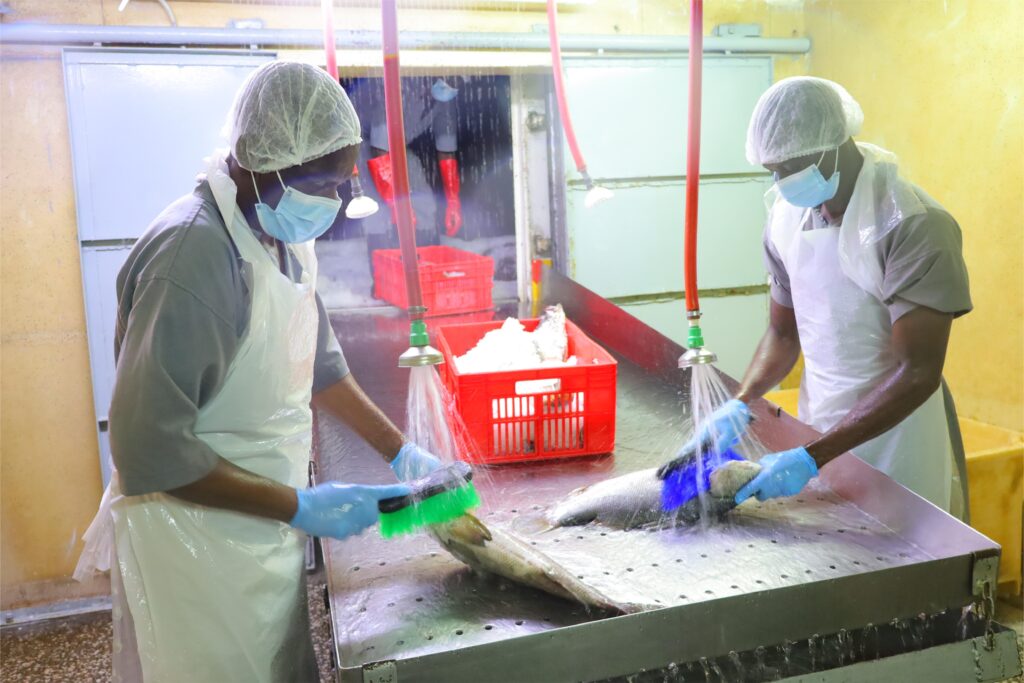
Workers cleaning fish at the East African Sea Food Limited company in Kisumu on December 10, 2025. Photo courtesy: KEPROBA
The decline in raw material, Xavier said, is largely due to illegal extraction of juvenile fish and brood eggs, as well as lake pollution.
“We don’t take fish from cages; we only depend on Nile Perch from the natural waters. And as you may be aware, the Nile Perch needs clean water to breed. That cannot happen when the lake is polluted,” said the general manager.
Xavier said the company adheres to strict regulations, only processing fish between 50 centimetres and 85 centimetres, but illegal practices and environmental challenges in the lake continue to threaten the fish stock. He warned that if lake pollution is not addressed as a matter of urgency, the company may be forced to close shop due to lack of raw material.
“The National Environmental Management Authority should work with all stakeholders to prevent lake pollution, that is their duty. Otherwise, the future looks bleak,” he emphasised.
For now, the operation continues unabated, with exports departing from Kisumu Port and Kisumu International Airport (KIA).
Each daybreak, refrigerated trucks belonging to the company move along beaches throughout counties bordering Lake Victoria – Kisumu, Siaya, Busia, Migori and Homabay – collecting fish from fishermen from who engage in night fishing activities. After collection, the washing, sorting and weighing is done, in that order, on location.
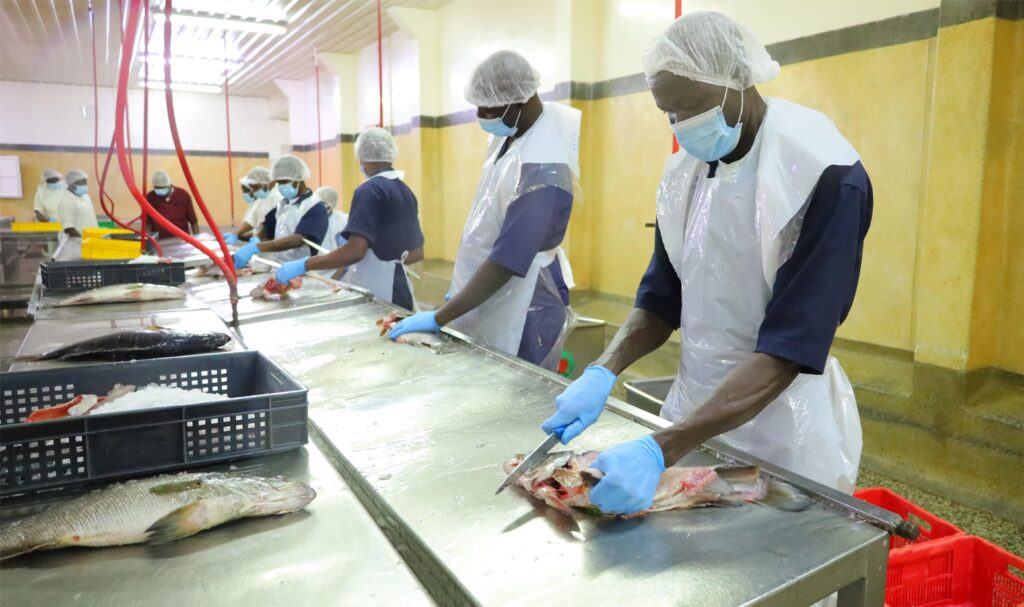
The trucks then head back to the factory where workers are on standby to start processing. The exercise begins with filleting, de-skinning, trimming, grading and bagging, and then freezing.
Packaging and strapping follows, then metal detection and storage in a cold store before dispatch to market. Xavier said frozen products are stored at minus 20°C to maintain freshness before export, while quality inspections and laboratory testing are done at every stage of processing, to ensure zero customer complaints.
Concerns over the long term viability of the operation persist, however. The general manager’s comments on pollution in Lake Victoria are hardly isolated. In March 2025, a World Bank report revealed that over the past 40 years, Lake Victoria’s water quality has declined due to pollution from agricultural runoff, untreated wastewater and industrial waste.
“If urgent action is not taken, the lake’s deterioration could deepen poverty, increase environmental risks, and threaten the region’s long-term sustainability,” the World Bank warned.
Efforts to save the lake from pollution are ongoing, according to Kenya’s President William Ruto who explained as much during the recent inauguration of the East African Community (EAC) Lake Victoria Basin Commission (LVBC) headquarters in Kisumu.
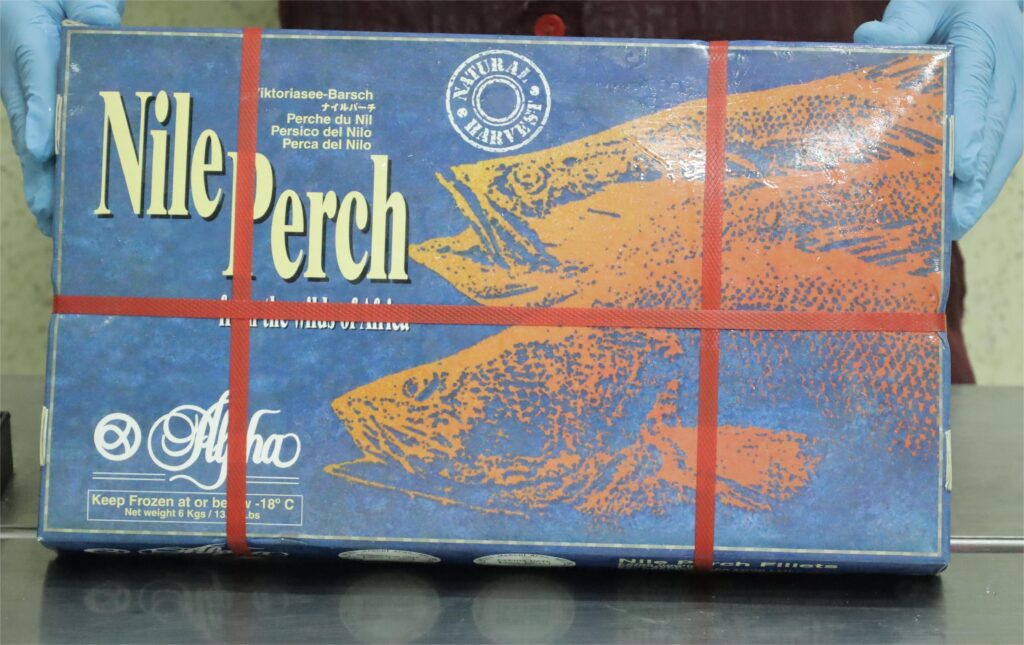
Packaged fish ready for the market. Photo courtesy: KEPROBA
According to the Kenya Export Promotion and Branding Agency (KEPROBA) CEO Floice Mukabana, Kisumu has a vibrant potential across various sectors such as fish, rice, agro-processing and manufacturing.
“Kisumu has a vibrant blue economy, and fish offers huge potential not just for consumption but for value addition,” Mukabana said as reported by the Star, during a recent forum with exporters in Kisumu.
Oliver Ochieng, Blue Africa News