
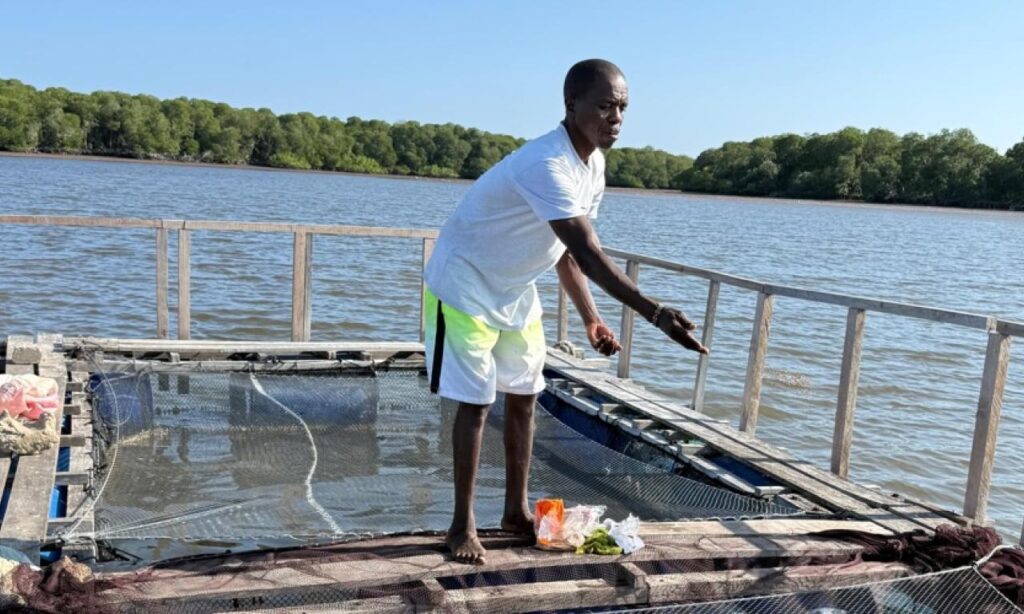
Researchers say the cost of feeds remains a challenge that needs to be addressed for Kenya’s aquaculture sector to boom.
by Blue Africa News
Kenya’s aquaculture sector continues to expand rapidly, but its long-term growth may be constrained by the steadily rising cost of fish feeds, according to findings of a study conducted by WorldFish with support from the Asia–Africa BlueTech Superhighway (AABS) project.
Findings of the study published by Reviews in Aquaculture indicate that the cost of fish feeds is holding back the sector, with far-reaching implications on income, food and opportunities for rural households.
Aquaculture or aquafarming refers to the controlled cultivation or farming of aquatic organisms such as fish, with the activity being popular in ponds and fresh water bodies like Lake Victoria in the Central, Nyanza, Western, Rift Valley, and Coastal areas of Kenya.
Despite it being a vital sector for food security, the cost of feeds remains a challenge that needs to be addressed.
“Fish feed now makes up more than half of production costs, contributing to over 60% of the total. The price of one kilo of commercial feed averages about US$1.24 (approximately Ksh160) which makes aquaculture an expensive business for small-scale farmers and young entrepreneurs entering the industry,” the study reveals.
This is so because most of the high-quality ingredients needed for nutritionally balanced feeds are imported, which exposes farmers to volatile prices and irregular supply.
“When global markets shift, local producers feel it immediately. For many farmers, the price of one kilo of feed has already reached around a dollar, a price that is unsustainable for those managing only a few ponds,” researchers Esther Magondu, Lucy Njogu, Kevin Ouko, Jimmy Mboya, Mavindu Muthoka, Rodrigue Yossa, Jonathan Munguti, Mary Opiyo, Menaga Meenakshisundaram, Chrysantus M. Tanga and Kevin Odhiambo Obiero found out.
“Our research found that the problem goes beyond price. Limited access to finance, fragmented policies, and inconsistent quality controls all compound the issue,” they added.
Many small mills and on-farm producers, they noted, lack the machinery and technical knowledge to mix feeds that meet nutritional requirements.
As such farmers, fish farmers often rely on local by-products like rice or maize bran as fish find. Unfortunately, the products are low in protein and high in fibre, and end up affecting fish growth and survival.
Luckily for the government, farmers and sector players, all is not lost. The study recommended that farmers and cooperatives be supported to produce their own feeds, using locally available ingredients.
“With the right training and equipment, they can learn to formulate balanced diets that meet the nutritional needs of different fish species. This can help reduce costs while creating new opportunities for small enterprises and local manufacturing.”
The research noted that insect-based proteins such as black soldier fly larvae, and other alternative ingredients show strong potential to replace costly imports and make feeds both cheaper and more sustainable.
Additionally, the researchers see reducing taxes on key feed ingredients, improving access to credit, and investing in training programs alongside policies that encourage collaboration between researchers, industry, and farmers as possible ways out of the current situation.
From the recommendations, Kenya can draw some practical lessons from Egypt – the African continental leader in fish production to grow its aquaculture sector.
Governmental support and dedication, and the availability of sufficient, quality commercial feeds are often mentioned as pillars of Egypt’s success.
“The thriving tilapia culture in Egypt is due primarily to unique characteristics and conditions, including use of simple farming technologies and systems, easy seed production, sufficient, quality commercial feeds currently available, governmental support and dedication, and favourable environmental and climatic conditions,” said Dr. Abdel-Fattah M. El-Sayed in an article published by Global Sea Alliance.
Egypt is currently among the top five largest tilapia producers globally.
Oliver Ochieng, Blue Africa News