The minister said Africa’s blue economy strengths lie in collaboration, sustainable management and deliberate policy planning.
By Blue Africa News
Ghana’s minister for fisheries and aquaculture, Emelia Arthur, has termed the blue economy as Africa’s current opportunity, calling on nations across the continent to actively tap into it to drive sustainable development.
The blue economy, the minister said, should not be seen as a distant ambition but as an immediate opportunity that African countries must actively pursue.
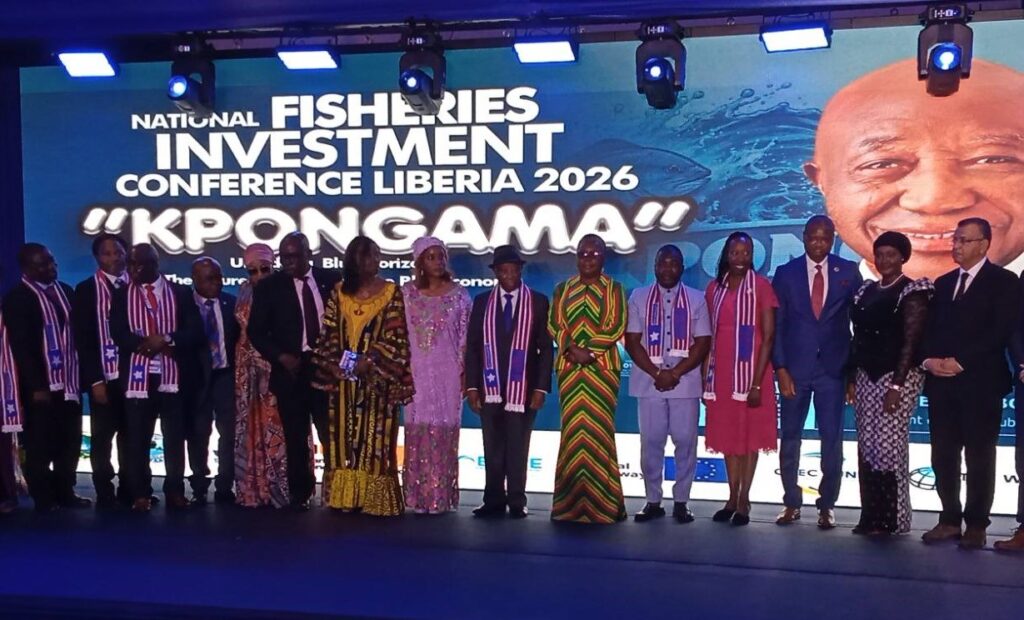
Speaking during the two-day (30-31 March 2026) National Fisheries Investment Conference 2026 in Liberia, branded ‘Kpongama’ – local dialect for “group gathering,” the Ghanaian minister called for stronger regional cooperation and strategic investment in Africa’s blue economy, reminding attendees that the future of Africa’s maritime and fisheries sector lies in collaboration, sustainable management and deliberate policy planning.
Using her country as an example, the minister said: “Ghana’s blue economy journey was built on policy alignment, scientific research, stakeholder participation, and strong political commitment.”
Ghana, she added, has developed and secured cabinet approval for its National Blue Economy Strategy. The strategy which is currently moving into implementation is built around six strategic priorities: Blue wealth, blue health, blue knowledge, blue finance, blue equity and blue safety and security.
Emphasising that West African countries share connected waters, fish stocks and climate risks, the minister said regional cooperation was essential, rather than optional.
“Countries along the Atlantic coast have the opportunity to build a blue economy that is regenerative, coordinated, and beneficial for future generations,” she noted.
Contrary to the assertion of many that the blue economy should be measured by the resources extracted from the ocean, she said she is convinced that the true value of Africa’s blue economy should be measured by the improvement in the lives of citizens through jobs, food security, resilience and economic growth.
‘Kpongama’ 2026 held under the theme of “Unlocking the Blue Horizons: The Future of Fisheries and the Blue Economy,” was attended by delegates from 21 countries across Africa, Europe, the Middle East, Asia and North America including the United States, China, United Arab Emirates Nigeria and Sierra Leone.
Attended by Liberia’s President Joseph Nyuma Boakai, the conference brought together investors, policymakers, fisheries experts and development partners, focused on expanding opportunities within what experts say is Liberia’s largely untapped fisheries sector.
Boakai declared Liberia’s fisheries sector “open for responsible and sustainable investment,” insisting that the new chapter is focused on improving livelihoods, increasing national fish production, and boosting revenue, not exploitation.
According to Cyrus Saygbe, the Director General of Liberia’s National Fisheries and Aquaculture Authority (NaFAA), the conference was a “historic platform” aimed at mobilising global investment, strengthening partnerships and accelerating development in the country’s fisheries and aquaculture sector.
Saygbe said fisheries was a key driver of food security, job creation, and private sector investment, adding that the sector is increasingly viewed as a cornerstone of national transformation, declaring that Liberia “is ready for business” in the blue economy.
“The tide is rising, the opportunities are here, and Liberia is ready for business.”
Data from NaFAA shows that despite Liberia’s 579-kilometer coastline and abundant marine resources, the country continues to import over 33,000 metric tons of fish annually.
Key initiatives announced during the Kpongama 2026 include the development of critical fisheries infrastructure such as a national fishing harbor, a modern fisheries complex, a state-of-the-art laboratory to meet export standards, a fish processing facility, and Liberia’s first integrated commercial aquaculture farm.
The efforts are being supported by international partners, including the World Bank and the OPEC Fund for International Development.
Additional interventions will focus on strengthening artisanal fisheries, deploying modern technologies to combat Illegal, Unreported, and Unregulated (IUU) fishing, and enhancing regional cooperation through frameworks such as the Fisheries Committee for the West Central Gulf of Guinea.
Oliver Ochieng, Blue Africa News