
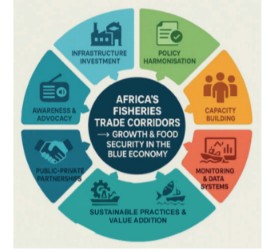
The AU-IBAR policy brief highlights the role of fish trade corridors in reducing post-harvest losses, and accelerating Africa’s blue economy.
by Blue Africa News
Regional cooperation and fish stocks will benefit from “Blue Corridors” that can be used to drive Africa’s economic growth and enhance food security within the blue economy framework, according to an inter-Africa research body.
The African Union’s Inter African Bureau for Animal Resources (AU-IBAR) in its policy brief titled “Developing Trade Corridors for Fish and Fish Products in the Context of the African Blue Economy,” published early December places a spotlight firmly on the role of such corridors in reducing post-harvest losses, improving food safety, strengthening livelihoods, and accelerating Africa’s blue economy.
Integrating fisheries trade corridors in the Blue Economy Strategy will contribute toward Africa’s food security and nutrition, the brief states.
“In the context of the Blue Economy, fisheries are one of the major economic components; and integrating fisheries trade corridors in the Blue Economy strategy will contribute towards Africa’s food security and nutrition, economic development, poverty reduction; and raise the overall return on investments in blue value chains,” brief reads in part.
The brief covers the development of the main fisheries trade corridors across West, East, Central and North Africa, within the context of the blue economy, with particular attention to the causes, impacts, and mitigation of post-harvest losses.
AU-IBAR research highlights the important role of existing, informal and formal trade corridors in connecting fishing communities to local, regional, continental and international markets, the integration of trade in fish and fisheries products into the broader blue economy strategies, and the systemic approaches to addressing challenges that undermine food security, livelihoods, and economic growth.
For example, the brief identifies the Dakar-Bamako corridor as the dominant fish trade route in West Africa, linking Senegal’s processing hubs to landlocked Mali and Burkina Faso.
“Ghana’s small oceanic fish products flow to Nigeria, Côte d’Ivoire, and the DRC via informal routes. Furthermore, in Cote d’Ivoire, distribution begins at wholesale fish markets in large urban centres such as Abidjan, with access to modern harbours, storage and processing centres,” the brief notes.
Traders along the route currently face numerous challenges, including high transport costs due to multiple checkpoints, non-harmonised sanitary standards, and racketeering at borders, inadequate cold chain infrastructure and exorbitant border taxes. Formal recognition and support for blue corridors would reduce the challenges and improve efficiency and commercial opportunities.
The East African corridor is dominated by the Lake Victoria Basin route, the Mombasa-Goma corridor and the Kenya-South Sudan-Uganda-DRC corridor. Some of the challenges on these routes include insufficient or lack of infrastructure at border points for sanitary checks, illegal trade in immature fish, illegal routes bypassing formal posts, and informal but powerful trade associations controlling trade operations outside official procedures.
In North Africa, there are minimal intra-regional corridors since major industry players – Egypt, Morocco and Algeria are focused on global markets.
The Libreville-N’Djamena corridor (Cameroon-Gabon-Chad) facilitates freshwater fish flows in Central Africa. Weak compliance with sanitary standards, high transport costs, and limited data on informal trade are the major challenges in Central Africa. However, this in itself represents another opportunity as markets across Africa open up.
For Africa’s blue economy to thrive, the policy brief recommends massive infrastructure upgrade across the continent.
“Upgrade cold chain facilities, transport appropriate packaging and networks, and border infrastructure to reduce post-harvest losses and facilitate efficient trade” it states.
It also calls for the alignment of regional standards, simplified documentation, and implementing OneStop Border Posts (OSBPs) to streamline cross-border trade.
“In addition, governments should put in place common conformity assessment procedures to be used by all countries to test, inspect and certify fish products for imports and exports. This will ensure that the products being placed on the market comply with all legislative and food safety requirements,” it adds.
Capacity building, the policy says, is also key as it will provide training and financial support to small and Medium Enterprises (SMEs), especially women empowerment and youth development, besides calling for sustainable practices and value addition, and encouraging collaboration between governments, the private sector, and NGOs to develop sustainable infrastructure and practices for Africa’s blue economy to boom.
Details of the brief marry with contents of the United Nations Economic Commission for Africa (ECA), which recently called for greater infrastructure investments in Central Africa, geared toward unlocking the potential of the blue economy in the region.
ECA said increased investment should be facilitated in enabling infrastructure and technologies for priority blue economy sectors, including by using public and development finance to build the necessary physical infrastructure.
Oliver Ochieng, Blue Africa News