
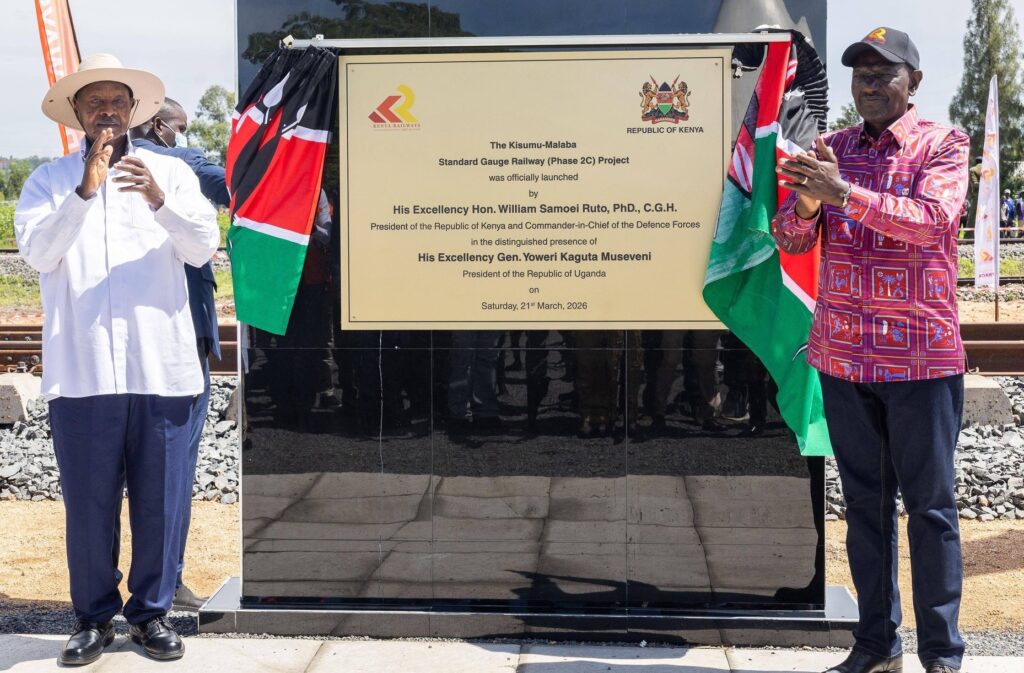
The nearly 1,000km railway line will be completed within three years, opening up the East African region, linking Kenya’s Port of Mombasa to Kampala in Uganda, Kigali, Rwanda, Juba, South Sudan and onwards to the Democratic Republic of Congo (DRC).
By Blue Africa News
The Naivasha-Kisumu-Malaba extension to Kenya’s Standard Gauge Railway (SGR) is being touted as a powerful statement of East Africa’s regional integration, partnership and shared ambition by Kenya’s president William Ruto, and his Ugandan counterpart Yoweri Kaguta Museveni.
Speaking during the ground breaking ceremony in Kisumu on March 21, 2026, the two leaders agreed that economies in the East Africa region are generating sufficient opportunities, but the gains are being pegged back with high logistic costs, undermining competitiveness.
“In many cases, transport and related costs account for between 30% and 40% of the final value of goods. Cargo takes on average 80 hours to move from Mombasa to Malaba and more than 100 hours to Kampala,” said the Kenyan leader.
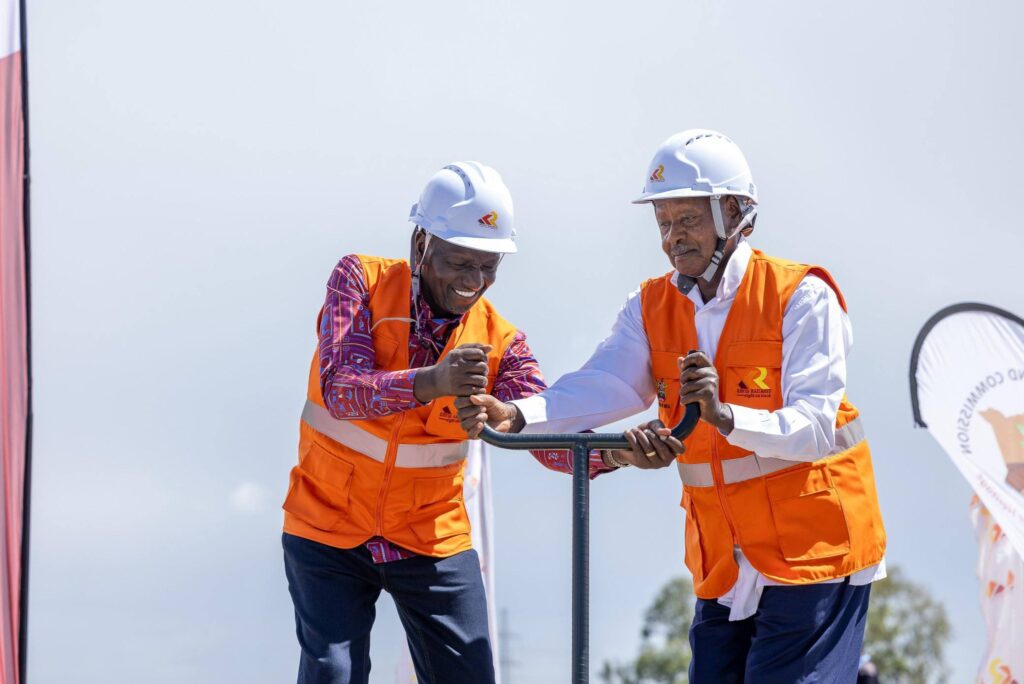
From left: President William Ruto (Kenya) and Uganda’s Yoweri Museveni during the ground breaking ceremony for SGR construction in Kisumu on March 21, 2026. Photo courtesy: Kenyan presidential communication service.
“We cannot build prosperity on inefficiency. That is why we must invest in modern efficient transport and connectivity systems not only as transport corridors, but also as economic corridors,” he added.
Along the Mombasa – Malaba corridor, Ruto said, they will promote the development of industrial parks, logistics hubs and commercial centres driven by private sector investment and anchored on regional integration.
“This is a proven model, one that has delivered rapid transformation by aligning infrastructure with industry, trade and investment.”
Construction of an SGR line from Kenya to Uganda has been long overdue. In 2008, Kenya’s third president, the late Mwai Kibaki and Museveni jointly laid the foundation for a modern, high-capacity railway.
In 2014, Kenya commenced the construction of Phase 1A of the SGR, stretching 472km from Mombasa to Nairobi. The SGR was later extended to Suswa, in Narok, covering 120km. A day before the Kisumu event, president Ruto launched the construction of SGR from Narok to Kisumu, a distance of 264km.
Expected to cost between Sh646 billion and Sh720 billion (approximately US$4.9 billion – US$5.5 billion), the railway line from Narok to Malaba, nearly 1,000km is set to be constructed within three years, linking Kenya’s Port of Mombasa to Kampala in Uganda, Kigali, Rwanda, Juba, South Sudan and onwards to the Democratic Republic of Congo (DRC).
Ruto said figures from the Mombasa-Nairobi SGR line offer a glimpse of the transformation in transportation of goods and people expected, once the Naivasha-Kisumu-Malaba line is up and running.
“Over the past eight years, the SGR has transported more than 15 million passengers and over 45 million tonnes of freight. It has reduced transport costs, improved efficiency and contributed significantly to the growth of our economy,” he observed.
He added, “But beyond the numbers lies something far greater. This railway will connect farmers to markets. It will move livestock and farm produce from Narok to Nairobi and onward to Mombasa for export. Tea from Kericho, dairy products from Bomet, grains from the Rift Valley and Fish from Lake Victoria will reach markets faster and more efficiently.”
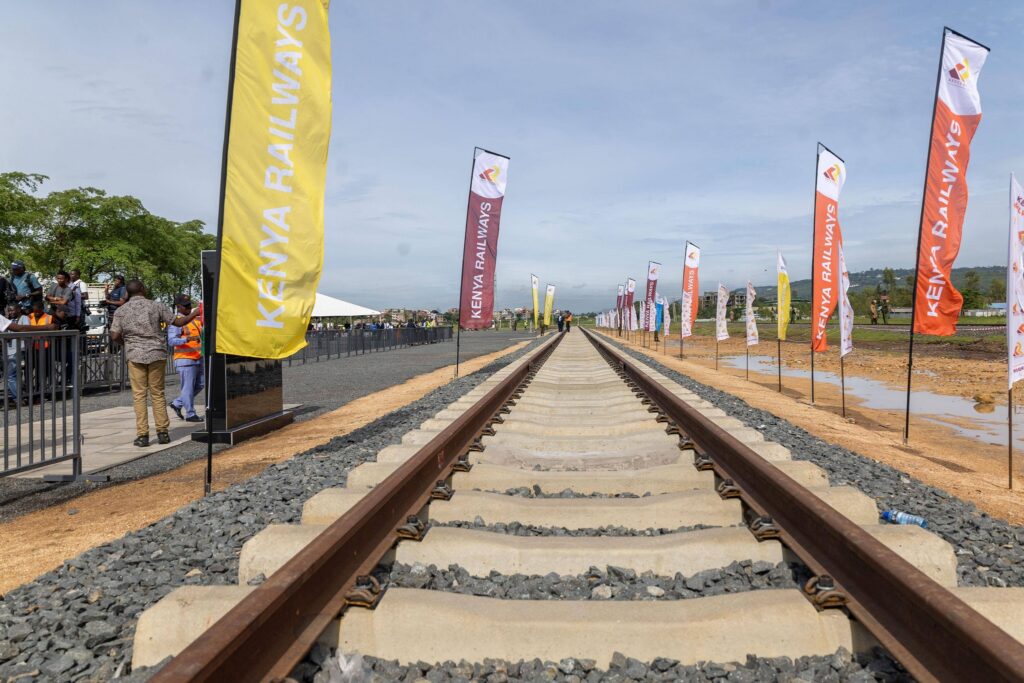
Ongoing SGR construction for the Kisumu-Malaba SGR in Kisumu. Photo courtesy: Kenyan presidential communication service.
The railway project, said president Museveni, is a key pillar in the rationalisation of East Africa’s transport system. “By shifting bulk cargo from roads to rail and pipelines, we reduce transport costs, protect infrastructure and improve efficiency.”
Kisumu governor Anyang’ Nyong’o said the construction marks a significant milestone in Kenya’s infrastructure development and regional integration efforts.
“This milestone represents not only progress in infrastructure development, but also a shared vision for growth, opportunity, and stronger regional integration,” said the governor, adding that the SGR project has long been a dream for many, with hopes that it will eventually connect the wider East African region, including Uganda and South Sudan, through Malaba.
According to the Kenya Railway, upon completion, the railway line will have a uniform design specification, which will permit seamless operation across the borders. Each freight train will have a haulage capacity of 4,000 tonnes (216 TEUS) with a designed speed of 80 kilometres per hour, while each passenger train will have a capacity of 1,096 passengers and with a designed speed of 120 kilometres per hour.
Oliver Ochieng, Blue Africa News