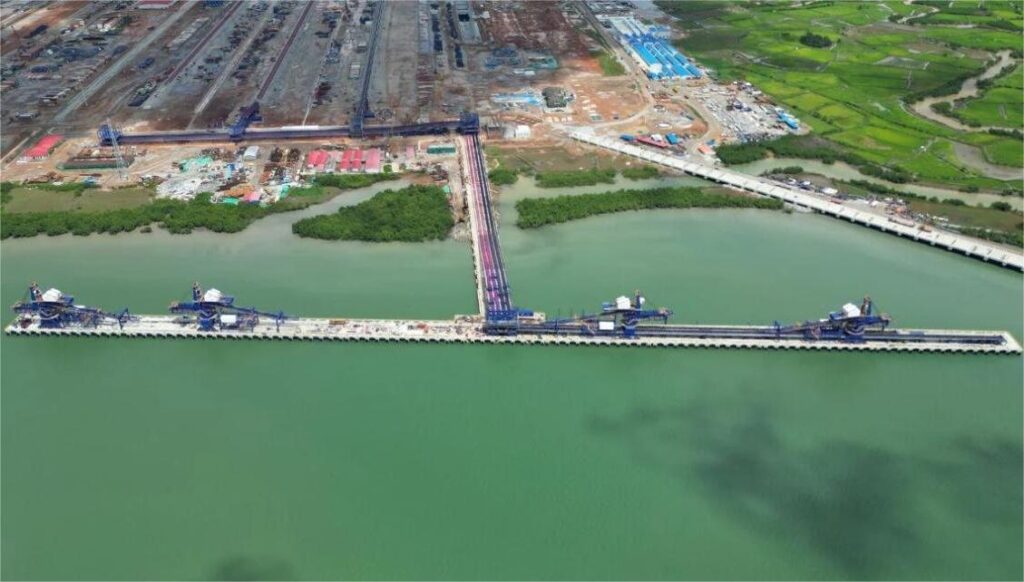
The Simandou mountain range in south-east Guinea is rich in subsoils which contain a world class reserve of high-grade iron ore.
by Blue Africa News
Guinea’s Simandou project has commenced commercial operations, turning the country into one of the world’s most important ore producers, overnight. In early December, a deep-sea vessel carrying 200,000 tonnes of high-grade iron ore departed Guinea’s Port of Maretapa for China, marking the first shipment from the Simandou project.
China Daily reported that the shipment signalled full activation of Simandou’s integrated industrial chain, encompassing mining, railway, port and maritime transport. The report sourced the announcement to the Aluminum Corporation of China (Chinalco), a leading developer of the project.
Situated in the south-east part of the Republic of Guinea, the Simandou mountain range is rich in subsoils which contain a world class ore reserve of high-grade iron ore.
Simandou is divided into 4 blocks with Rio Tinto, a British-Australian multinational company holding the rights to blocks 3 and 4 through Rio Tinto SimFer, a joint venture with the Government of Guinea and other partners, including Aluminum Corporation of China (Chinalco).
The other two are controlled by Winning Consortium Simandou (WCS) backed by Chinese companies including China Baowu Steel Group.
“Under a phased implementation plan, Simandou is expected to reach an annual production capacity of 120 million tons from both blocks. Once fully operational, Guinea could emerge as the world’s third-largest iron ore supplier, after Australia and Brazil,” Rio Tinto notes in its website.
According to Isaac George, an out-ports audit expert, the Simandou project is expected to transform Guinea’s economy, and make it Africa’s second-largest mineral exporter once production scales up.
“Construction of the Simandou mines cost US$20 billion, making it the largest mining project in Africa. It contains the world’s largest untapped iron ore deposit with 4 billion tonnes of untapped high-grade iron ore,” he said in a recent LinkedIn post.
The project has two mines, a 670-kilometer railway, 12 train stations, more than 200 bridges, and 4 underground tunnels to transport the iron ore from the site to the seaport, courtesy of the US$20 billion investment.
According to Tre Hunt, a growth and expansion expert, however, Simandou is much more than a mine.
“It is a geopolitical operating system that drops Guinea into the iron ore triangle between China, Australia and Brazil,” he said.
Hunt said Guinea’s administration must work hard to avoid becoming just another high-grade quarry for “someone else’s strategy,” applauding the government for, so far, forcing all partners into a shared rail and port system instead of parallel, foreign controlled lines, keeping a meaningful equity stake so that part of the output can be marketed independently, including to European and Middle Eastern green steel producers and pushing back when any single partner looked too dominant.
Over the next five years, added the expert, Guinea will need to walk a narrow line between China’s desire for cheaper ore and its own need to capture more value, shipping everything to Asia and building a role in green steel value chains closer to Europe and the Middle East and demands of global majors and the expectations of local communities and workers.
“The first Simandou ship has sailed. The real test is whether Guinea can convert that 200,000-ton cargo into lasting bargaining power, not just royalties and headlines,” he insisted.
Beyond volumes, experts say Simandou’s high-grade ore also fits into the broader push for lower-carbon steelmaking, offering potential benefits in blast furnace efficiency and emissions reduction.
Production at the Simandou project began on November 11, 2025 as a government official referred to it as more than a mining project.
“Simandou is more than a mining project: it is the driving force behind a national transformation,” Djiba Diakité, Minister and Chief of Staff to the President of the Republic, said as reported by mining.com.
“This inauguration marks a foundational milestone for Guinea, which now stands as a key player in sustainable development and economic sovereignty in West Africa,” added Diakite.
Oliver Ochieng, Blue Africa News