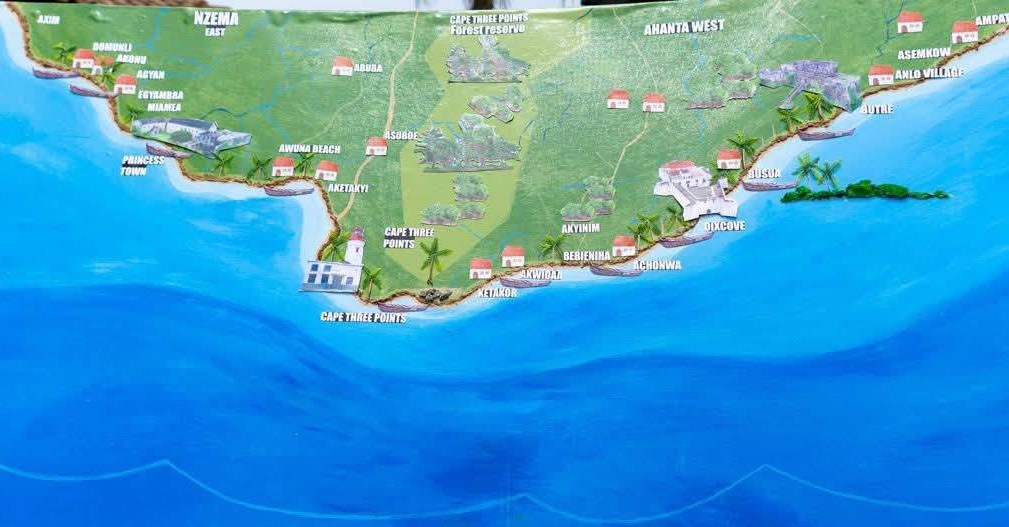
Ghana’s newly declared Marine Protected Area (MPA) spans a strategic ecological zone that connects over 21 coastal communities, reflecting a balanced approach to conservation.
By Blue Africa News
Ghana’s effort toward safeguarding its marine ecosystem has received a major boost, following the official declaration of the Greater Cape Three Points Area as the country’s first-ever Marine Protected Area (MPA), after over 15 years of preparation and waiting.
An MPA is a section of the ocean where a government has placed limits on human activities. The limited activities include allowing locals to utilise the areas in ways that do not exploit the environment.
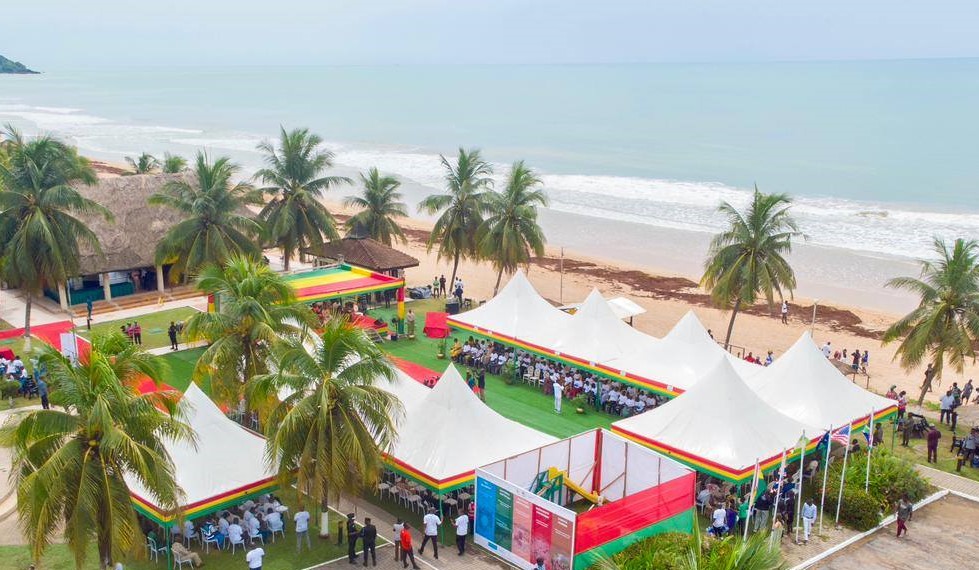
On Tuesday (April 14) Ghana announced a landmark MPA during a ceremony held in Busua, in the Western region presided over by the Vice President, Naana Jane Opoku-Agyemang.
“Protecting the ocean is ultimately about protecting our people, as millions of Ghanaians depend on the productivity of our marine environment,” said the Vice President.
“The government remains committed to supporting coastal communities through sustainable alternatives, infrastructure development, and inclusive policies, while ensuring that the MPA delivers real impact. Long-term success will depend on partnership, compliance, and shared responsibility.”
She declared the Greater Cape Three Points Area a Marine Protected Area, pursuant to Section 39 of the Fisheries and Aquaculture Act, 2025 (Act 1146), and in accordance with the October 2025 cabinet approval.
The newly designated MPA, noted the Vice President, spans a strategic ecological zone that connects over 21 coastal communities in Ahanta West and Nzema East and reflects a balanced approach to conservation.
The initiative, she added, is not about restricting fishing communities but “about ensuring sustainable practices that allow marine ecosystems to regenerate, thereby securing long-term food security and economic resilience.”
Emelia Arthur, Ghana’s minister for fisheries and aquaculture hailed the declaration, describing it as a defining moment in the West Africa nation’s environmental and fisheries management history.
“Today, we do not merely gather; we make history,” the minister made a bold declaration.
“This moment will be remembered as the day Ghana took a bold and irreversible step to protect her oceans, restore her fisheries, and secure the future of her coastal communities.”
Despite Ghana’s Greater Cape Three Points area being known for its rich marine biodiversity and its importance to local livelihoods, particularly fishing communities, it has over time, faced increasing environmental pressures, including overfishing and habitat degradation.
Designation of the MPA marks a major policy milestone, signaling a shift in Ghana’s approach to marine resource management.
“The achievement is the result of an extensive collaboration among multiple stakeholders, including government agencies, academia, civil society, fisheries associations, and development partners,” she said.
She also commended members of the technical advisory committee for ensuring that the MPA designation process was grounded in scientific evidence, and aligned with international best practices.
“This is not an end; it is a beginning. The beginning of a network, the beginning of restoration, and the beginning of a future where conservation and prosperity go hand in hand,” she emphasised, adding that the MPA is expected to support the recovery of fish stocks, restore degraded ecosystems, and enhance the resilience of coastal communities.
Besides environmental conservation, the MPA is expected to facilitate infrastructural improvements in the area, including upgrade of roads, schools and health facilities.
Ghana now joins a growing number of Africa countries with at least an MPA as conservation along the continent’s coastlines continues to receive the attention it deserves.
South Africa leads in the number of designated MPs across Africa, with over 40. As of 2020, South Africa had 42 MPAs covering 5% of the country’s national coastal waters. The number was just 0.43% prior to 2016.
Oliver Ochieng, Blue Africa News