
The project aims to consolidate the Nacala Corridor as a strategic axis of regional integration, ensuring landlocked countries efficient access to the Port of Nacala, in northern Mozambique.
by Blue Africa News
The extension of the Nacala Railway Corridor (NRC) received a new lease of life in December 2025 after the governments of Mozambique, Malawi, Zambia and the Democratic Republic of Congo (DRC) signed a ministerial declaration, marking a major step toward establishing a competitive logistics link to the Indian Ocean.
The project, according to Mozambique’s ministry of transport and logistics, targets an integrated rail network of about 2,400 kilometers, running from Zambia’s Chipata area to Serege in DRC, passing through Malawi and Mozambique.
“This is the path for the Port of Nacala to establish itself as a driver of regional integration and a catalyst for shared economic development,” said Mozambique’s Minister of Transport and Logistics, João Matlombe in a statement.
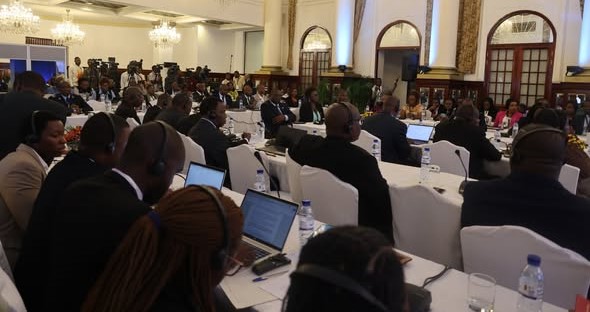
Matlombe spoke during the 10th meeting of the Nacala Development Corridor Management committee held in Maputo, attended by the ministers responsible for transport and logistics from the aforementioned countries.
The project, Matlombe added, aims to consolidate the Nacala Corridor as a strategic axis of regional integration, ensuring landlocked countries efficient access to the Port of Nacala, in northern Mozambique.
“This project will be an example of African cooperation and shared strategic vision. The Port and the Nacala Corridor are not just physical infrastructures. They are symbols of hope, progress and regional integration,” he noted, adding that the “region can be an example of cooperation and real economic development.”
He challenged governments of the four countries to start moving with speed for joint mobilisation of funding, and identifying strategic partners for the construction of the railway line, alongside associated logistical infrastructures along the corridor.
With the signing of the ministerial declaration and an agreement on a joint funding, the minister said the next cause of action is the signing of an agreement in the first quarter of 2026, that will allow the partner states to identify a strategic partner for the construction of the railway line, and logistical facilities along the corridor.
The World Bank, in a May 2025 report titled “Transport Corridors for Economic Resilience – Mozambique,” says Nacala Corridor is one of the six key agricultural development corridors for Mozambique, playing a leading role in the country’s northern region, highly regarded for crop production.
“Each corridor has a specific product focus, with the overall aim of boosting agricultural commerce and development in these targeted areas. The northern regions, including Nampula and Niassa, have immense potential for agricultural production, national food security and employment generation given their fertile soils. In the Nampula and Niassa provinces, there is strong agricultural potential in crops such as pigeon peas, cashew nuts and sesame seeds,” the reports read, in part.
“Yet only a fraction of the land is utilised efficiently due to constraints in infrastructure, access to inputs, and inadequate policy frameworks. Farmers are not able to fully access regional markets due to poor road infrastructure while the lack of investment in tertiary roads hinders last mile connectivity,” it adds, as the corridors’ new development plans serve as good news to Mozambican farmers.
The report however notes that over the past decade, approximately US$6.2 billion in investments has transformed the regional transport infrastructure of the Nacala corridor, in addition to the governments of Malawi and Mozambique rehabilitating of over 1,000 km of main roads, and 350 km of feeder roads at a cost of approximately US$1 billion.
With the development of the Nacala Railway Corridor expected to pick up, 2026 seems to be a big year for some of Africa’s most important infrastructure projects linked to the DRC.
The United States of America (USA), through the International Development Finance Corporation (DFC), along with Development Bank of Southern Africa signed a US$753 million loan agreement for the Lobito Atlantic Railway (LAR), to support the rehabilitation and operation of the Angolan section of the railroad network.
The 1,739km LAR connects Kolwezi in the Democratic Republic of the Congo to the Port of Lobito in Angola.
Oliver Ochieng, Blue Africa News