
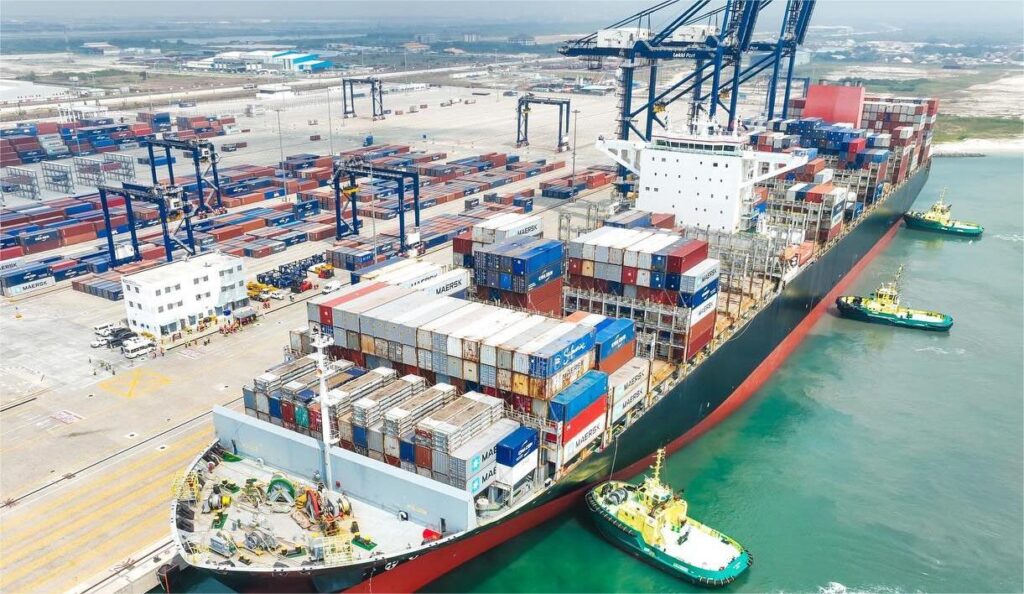
Bakassi Deep Seaport to serve as a new maritime gateway for North-Central and North-East Nigeria.
By Blue Africa News
Nigeria’s Federal Executive Council (FEC) has announced the approval of three major Public-Private Partnership (PPP) projects worth over ₦6.43 trillion (US$4.29 billion), aimed at strengthening the country’s infrastructure, boosting economic competitiveness, and attracting private-sector investment.
Dr. Jobson Ewalefoh, the Director-General of the infrastructure concession regulatory commission (ICRC) in a statement issued on his behalf by acting Head of Media, Ifeanyi Nwoko, said the approval reflects practical outcomes of the Nigerian government’s renewed hope agenda.
The agenda is pegged on private-sector-led infrastructure development for national growth, economic competitiveness, and large-scale job creation.
Bakassi Deep Seaport is part of the projects. “The three projects, fully funded by private investors, include the Bakassi Deep Seaport (2.27 billion dollars) and the Port of Ondo Deep Seaport (1.14 billion dollars), along with the 460MW Katsina-Ala Hydropower Plant,” said the Director-General as reported by marketfoces.com.
The Bakassi Deep Seaport, he said, will serve as a new maritime gateway for North-Central and North-East Nigeria, while the Ondo Deep Seaport will unlock solid minerals and agro-allied potential.
“The Bakassi Deep Seaport, a greenfield development will accommodate large vessels, integrate an industrial cluster, and establish a free trade zone, creating thousands of jobs and boosting Nigeria’s maritime competitiveness.”
According to Nigeria’s national policy on marine and blue economy, the nation’s seaports and dry ports serve as important hubs for commerce and trade, both domestically and globally.
The seaports, situated across nine coastal states in the country, include the Apapa Port Complex, Tin Can Island, Port Harcourt, Onne Port, Delta Port, Calabar Port, and Lekki Deep Seaport, while the inland dry ports include the Kano, Kaduna dry port, and the recently commissioned Funtua Inland dry port in Katsina State.
“The two ports in Lagos (Apapa and Tin Can Island) process about 50-60% of seaborne cargo that comes into Nigeria. And while about 60% of the cargo destined for West Africa is Nigeria cargo, Nigeria is yet to realise her ambition of becoming the maritime hub for West Africa. This is due in no small part to infrastructure gaps and the low competitiveness of its ports compared to other neighbouring ports in the region,” the policy, approved by FEC in March, 2025 reads in part.
Efforts are ongoing to develop more deep seaports in the country, whilst closing infrastructure gaps and improving the efficiency of processes at the existing ports, with PPP deals being used as a strategy to fund some of the projects.
The Port of Ondo is also known as the Ilaje Deep Seaport) and is situated in Erona, Ondo State, near Benin.
According to the policy, the country’s strategic aspirations for the port infrastructure and related services include providing efficient and competitive port services in a safe and secure environment to facilitate domestic and international trade, achieving 24 hours vessel turnaround time and 48 hours container cargo clearance, facilitating seamless connection of the port infrastructure to road, rail, and inland waterway networks and increasing the number of fully operational deep seaports in the country.
Within the policy, it is clear that Nigerian ports are faced with challenges of inadequate infrastructure capacity, coupled by insufficient port facilities and limited application of modern technology hindering the movement of cargo, increasing delays and operational expenses.
“The road network leading to the ports are sometimes in poor condition, resulting in bottlenecks and delays in the transit of cargo to and from ports,” the policy notes, adding that most of the country’s major ports are congested due to insufficient space, overtime cargo, and suboptimal port management practices.
“Administrative procedures at the ports are lengthy and cumbersome due to the high number of government agencies physically involved in the cargo clearance process. This promotes delays, mismanagement, and fraudulent activity. These inefficiencies raise the cost and time required to clear products, significantly impacting international trade.”
The policy was designed to harness the country’s marine and aquatic resources to drive economic growth, job creation, environmental sustainability, and private-sector investment.
Oliver Ochieng, Blue Africa News