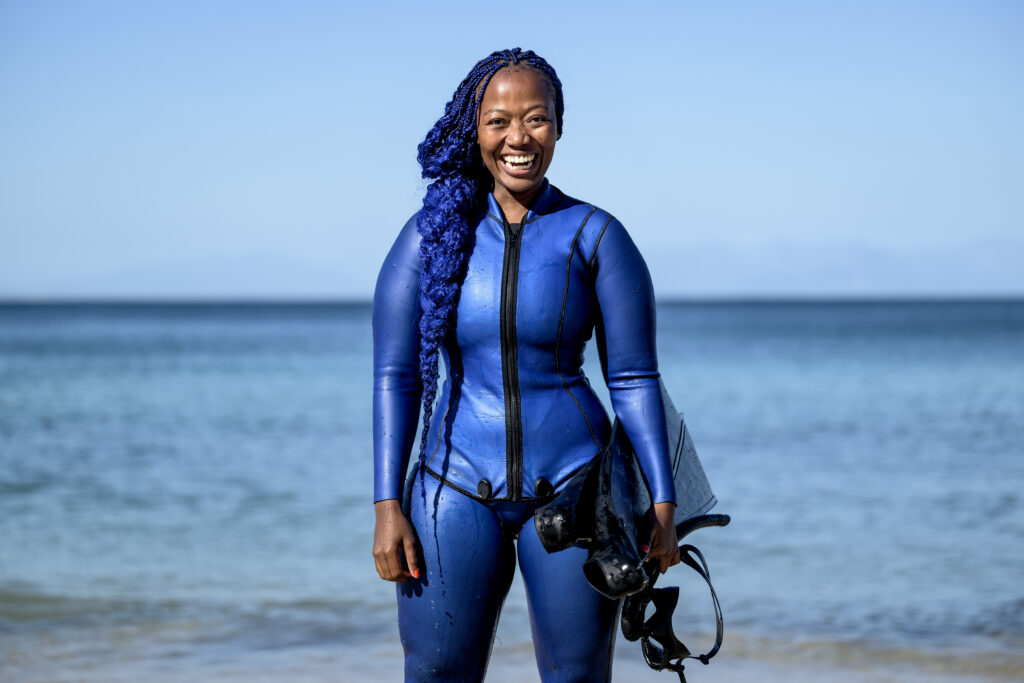
Zandi Ndhlovu fell in love with the ocean in 2016, and since then, she has never looked back. She describes the ocean as a holy and sacred place where “I needed to be.”
By Blue Africa News
Zandile Ndhlovu, popularly known as ‘Zandi The Mermaid’ is living her dream. The 37-year-old South African is a freediver, conservationist and storyteller based in Cape Town. As a freediver, Zandi is a Professional Association of Diving Instructors (PADI) certified instructor, besides being a scuba certified diver.
She is the founder of the non-profit Black Mermaid Foundation, an organisation working to create diversity in the ocean spaces through educational snorkel trips and ocean facing excursions, with a view of “ensuring ocean guardianship also looks like us by creating access.”
To better understand her experiences and fears in the ocean around the world, Blue Africa News emailed her a set of interview questions. Below are excerpts for part one of the two-part question and answer run.
What first inspired you to become a diver and photographer?
I’d seen many ocean conservation films that never looked like us – part of why I went into film and documenting my world. But in the beginning, it was to share this love and space with friends and family, also a hope that if a kid came across the ocean, wanting to work or explore here, they would see someone that looks like them. There’s a power in representation.
Over time, it was a desire to tell stories and interestingly enough, I was always very insecure about sharing my photos, only actively working at putting them out more intentionally in the last 2 years.
Wildlife photography is highly un-diverse, and underwater even less. So, a lot of the photographers in the space have been doing this for over 20-30 years. This scared me a little… and then I decided to be brave, and in my storytelling brave the space to dare call myself a photographer, too.
The journey of storytelling comes from my grandmother, an amazing storyteller that bridged narratives for me about our connection with nature and water as Black people, something that’s been lost in our communities as ‘civilization’ narratives took root.
My photography is a lens held by my traditional beliefs as a Black Zulu woman, a conservationist and deep lover of our oceans, but probably above it all, it’s as a Black woman.
And the ocean came to me in 2016, from a snorkel trip in Bali – I fell in love and came home to start Scuba diving then later freediving. Freediving felt holy, sacred – where I needed to be, and that’s how I left everything including my consultancy at the time to pursue her.
How long have you been doing these?
We mark 10 years this year, after falling in love with the ocean in 2016, an affirmation of deep belief systems but also finding belonging, I pursued scuba, which was incredible and helped me bridge the fear that I held for all deep bodies of water and the life within them – especially as someone who grew up in Soweto, a landlocked area.
I quickly realised that something was missing, a home feeling that I’d felt in 2016, I would find this feeling again when I discovered freediving in 2018 and went for my PADI zero to hero freediving course in 2019, going on to qualify in 2020 as a freediving instructor, becoming SouthA Africa’s first Black Freediving instructor.
What training or certifications are required to become a diver?
In order to be able to dive, you do need to be certified by a scuba authority like PADI, and in Scuba I’m certified to Master Rescue level which is just below Dive Master and, I’m a freediving instructor, a core of my underwater photography and exploration.
The only thing you need to be a diver is to know how to swim (not Olympic level but enough to know how to save yourself), everything else you learn as you go.
I am a keynote speaker globally. I do film work with organisations across the world like Discovery Channel in the US, but also, I love exploring the world’s oceans, so I travel a lot and document what I see, which is the photography that is in the world right now.
The ocean space has afforded me space into worlds unimagined, like speaking at Global Ocean conferences too.
What does a typical day look like for you when you’re on a diving mission?
Wake up early, like 5.30am to kit up and check camera gear. 6am is breakfast, on the water by 6.30 am. The days are beautifully long; we watch the sunrise on the water – this is simply the most magical time on the ocean.
It’s wild… it’s when predation is most likely to happen, it’s when you see whales and all kinds of magical things. The ocean is vast and some days she has a lot for you and other days you’re just thankful to be spending the day with her – with very little to be seen.
There’s a gratitude that I must hold, because it’s easy to look out and hold wild expectations of who she should be for us, but as a Black woman, she’s asking for permission to be there, she’s holding her sacred… all ocean days are the best days, regardless of what we find.
The day ends at about 4 or 4.30pm typically (heading back to land) and then its washing gear, washing your camera gear and then around 6pm is dinner. Between washing gear and dinner you hope to catch a snippet of your captures but also, I’ve learnt to pause, less rushing to the capture because what’s amazing is, strangers here quickly become friends and each night after a long day on the water, everyone comes to show and share their captures and tell powerful stories of conquering fears and moments of impact through the day, a golden thread forever ties us together from then on, which means the days just get bigger and bigger simply because we’re expanding too.
Which places do you find diving and photography amazing in South Africa and out of the country?
Oh, that’s a tough one! In South Africa there are three places that are amazing all year – Sodwana Bay in KwaZulu Natal (KZN), a top 10 diving destination actually. There you could encounter absolutely anything. The Indian Ocean is this – that’s what makes her magical, mantas whale sharks, whales but also the most pristine coral reefs with teaming life… loud coral beds… she’s amazing! (And relatively blue water)
And Aliwal Shoal also in KZN is fantastic for sharks – you’ll see a variety of big shark species and wrecks here, and of course Cape Town’s kelp forests are a magical wonderland of golden forests and her huge boulders!
As the kelp sways in the water, between the magic is octopus, pyjama sharks and quite literally a candy store of colours… oh she is beautiful! (And her waters have been cleaning you nicely more and more over the years – pristine blue days are mind-blowing!)
And in the world, three places: Hawaii, huge biodiversity plus the bluest waters you’ll find!! Aaaah! and Tiger shark interactions like no other.
Egypt, so incredibly biodiverse and the water is warm too!
And Mexico… Baja California… oh my heaven… I wouldn’t even know where to start, but she may be the Mecca of diving.
All these places are amazing from a biodiversity perspective, but photography is a hard pin because so many things must go right, like good visibility, being on the right side of wildlife (because they don’t pause for you) and the sun, and because I shoot manual, you’re continuously changing settings while holding your breath trying to capture the shot… it’s another world completely, but to be in the water is first, you might miss many incredible captures because you’re in absolute awe.
What is the most beautiful thing you have ever seen underwater?
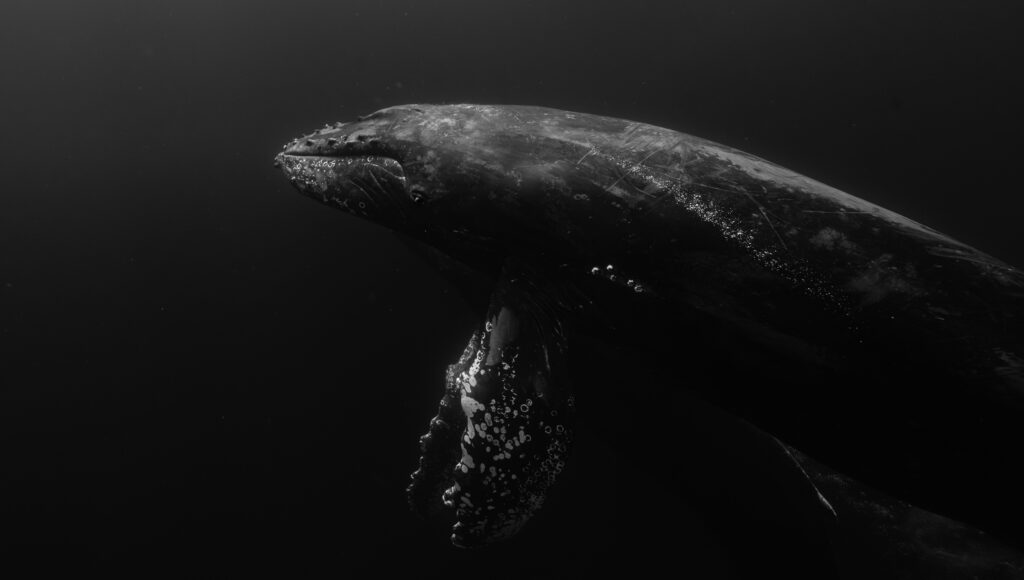
Aaah this is a hard question… probably the first time I saw a humpback whale mom and calf pair, it was just them two, and the baby was still learning how to use its tail, how to hold its breath to be underwater, and the mom was doing all things that human moms do, helping set the tone for life with this little one, starting with knowing how to use that powerful fin the calf has.
Have you ever encountered a dangerous situation while diving? What happened and how did you come out of the situation?
No not really, not with wildlife at least, but the one time I got lax with checking tides and had forgotten it was the full moon which meant when we tried to exit our shore entry, it was near impossible purely because of the power of the waves, with my underwater housing in hand was bracing and craziness and finally scraping out the water finally, a huge reminder to check the tides and the moon, every single time.
What marine animals do you see most often during your dives? Have they ever threatened your life?
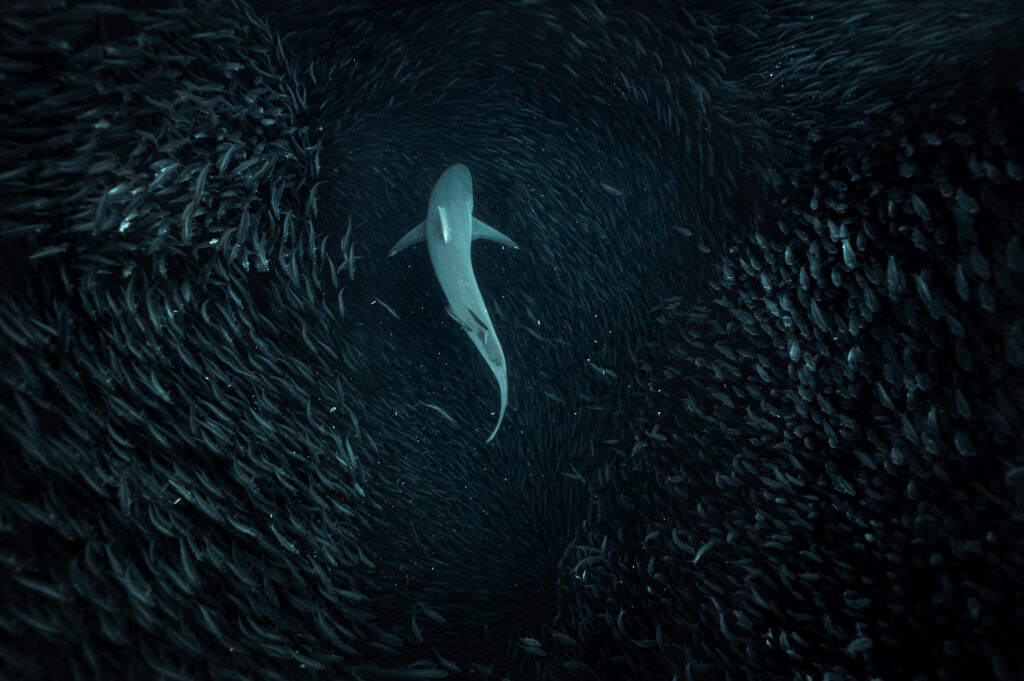
In Cape Town our waters have smaller life, so least concern but I see seals and probably Bull sharks the most. I absolutely love these encounters. And no, never felt or been in danger with them
Is there a dive or a photo you took that stands out as the most memorable in your career?
This is a hard one. It is a hard toss between the humpback whales looking back at me, Great hammer head sharks and a picture of a fisherman from Costa Rica, the first picture I would go on to print and hang in my home, purely because our interaction surpassed language – it as heart a realization how rarely words need to be spoken to be understood.
He was Spanish and didn’t speak English and I don’t know Spanish, and yet we come to this moment when he says I should take a picture of him, and as we go, he throws the line and in the multiple clicks of my camera was seeing the boy, the man and now the older gent that has lived with these waters, the line han sing in the year for seeming eternity as it weaves in the air, the way the sun hits his eye… actually of all my pictures, I’m brought to tears when I tell this story because land can be harsh, hard, filled with preconceived ideas, and yet in this moment past everything with this camera was a connection and a bridge, I’m a mosaic of this moment.
The ocean is home for me, less daunting and so my best here would be the humpback whale, also because how long it took for me to be able to lift my camera and take the photo, I’d been at a loss each time I’d seen them, brought to tears by the sheer magnitude and gentleness they are. And then one day, this encounter happened and between the awe, I lifted my camera to snap what we have today, no clue of how it would look, and didn’t look at the pictures for a few weeks.
What are the biggest risks associated with diving?
Hmm… the biggest risks are associated with the diver rarely wildlife, so if freediving – diving within your limits, if you have a camera, staying aware of your group if in scuba, making sure you’re not too deep and overstay your breath hold ability, and always holding an active awareness of the sharks around when diving because they are still wild animals, self-awareness and self-management is key in diving.
Oliver Ochieng, Blue Africa News
Check out for part two: https://blueeconomy.africa/zandi-2/
Photo credits: Craig Kolesky and Maysa Santoro