
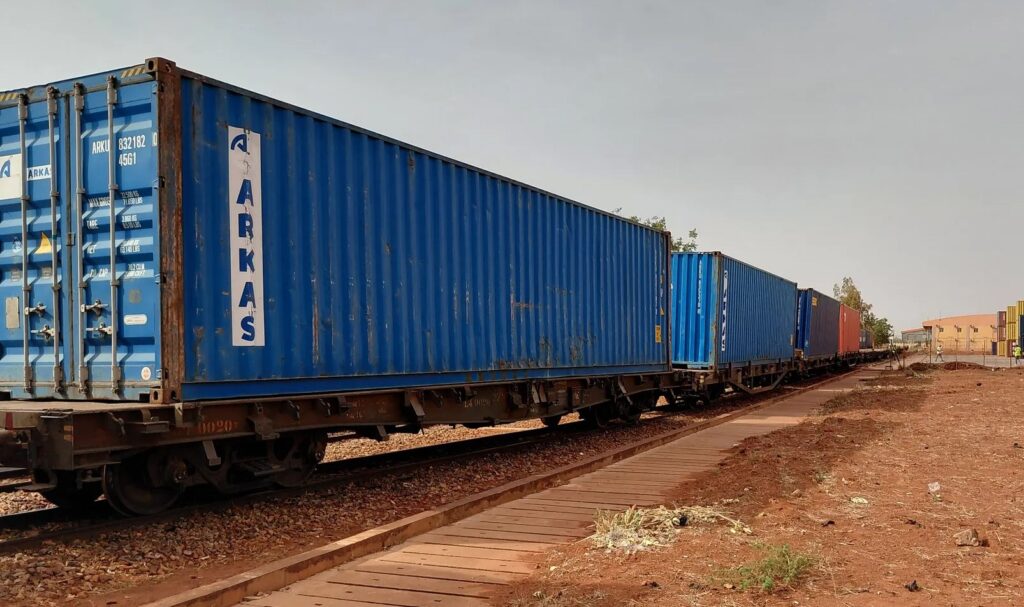
Commodities being transported from Côte d’Ivoire to land-locked Mali and Burkina Faso, including fuel and petroleum products, food and agricultural products and construction goods, are benefiting due to expanding trade corridors.
By Blue Africa News
In a bid to accelerate intra-African trade, Africa Global Logistics (AGL) has announced the opening of a new corridor linking Abidjan, Côte d’Ivoire to Bamako, Mali via the Bobo-Dioulasso dry port in Burkina Faso, combining rail and road transport in one of West Africa’s key trade routes.
AGL, known for providing integrated logistics, port, maritime and rail solutions in a statement said the corridor is part of its strategy to strengthen connectivity between Côte d’Ivoire, Burkina Faso and Mali, aimed at facilitating the movement of goods and supporting the development of regional trade.
The route is designed to meet the needs of manufacturers and economic players facing tight deadlines, with coordination between the customs services of Côte d’Ivoire, Burkina Faso and Mali presiding over a seamless transport system along the corridor.
“This new corridor represents a major step forward in securing and streamlining supplies to Mali,” said Salif Ouattara, General Manager of AGL Mali.
“It demonstrates our ability to structure, with all stakeholders, concrete, reliable, and competitive solutions within a challenging logistics environment. These solutions are tailored to the realities on the ground and serve businesses and the country’s economic development.”
Dino Ballestra, chairman and CEO of Comafruit stated that the new corridor has greatly contributed to the efficiency of their supply chain.
“We are fully satisfied with the transit times met by AGL Mali. The speed and reliability of the deliveries greatly contributed to the efficiency of our supply chain,” said the CEO.
“We particularly appreciate the consistency and professionalism of the team throughout the entire process.”
Key commodities being transported along the corridor, from Côte d’Ivoire to land-locked Mali and Burkina Faso include fuel and petroleum products, food and agricultural products, industrial or construction goods, consumer goods and manufactured products, vehicles, spare parts, and machinery among others.
On the other hand, exports from Mali and Burkina Faso to Abidjan include raw materials such as cotton, beef and mining products.
Mali and Burkina Faso are among 16 landlocked countries in Africa, which means they lack direct access to the sea, hence relying on neighbours for trade. Others are: Botswana, Burundi, Central African Republic (CAR), Chad, Ethiopia, Eswatini (formerly Swaziland), Lesotho, Malawi, Niger, Rwanda, South Sudan, Uganda, Zambia and Zimbabwe.
Corridors are considered vital for Africa’s economic transformation, regional integration and sustainable development.
Experts say by linking landlocked nations to seaports, the routes reduce trade costs, accelerate industrialisation under the African Continental Free Trade Area (AfCFTA), and boost regional growth, besides facilitating access to essential services and infrastructure development.
As such, various infrastructure upgrade projects are ongoing in several parts of the continent, with financing coming in from development partners within and out of Africa.
For instance, the Lobito Atlantic Railway (LAR) landed a rail financing deal signed in Washington in mid-December. The United States of America (USA), through the International Development Finance Corporation (DFC), along with Development Bank of Southern Africa signed a US$753 million loan agreement for LAR to support the rehabilitation and operation of the Angolan section of the railroad network.
The 1,739km LAR connects Kolwezi in the Democratic Republic of the Congo (DRC) to the Port of Lobito in Angola, “unlocking the fastest, most reliable and secure import and export trade route from the DRC Copperbelt to Africa’s west coast.”
LAR supports mining companies, freight operators and regional traders by transporting copper, cobalt, sulphur, reagents, fuel, agricultural, industrial and commercial products to and from Angola and the DRC.
All bulk and container shipments are handled through two state-of-the-art terminals at the Port of Lobito.
Oliver Ochieng, Blue Africa News