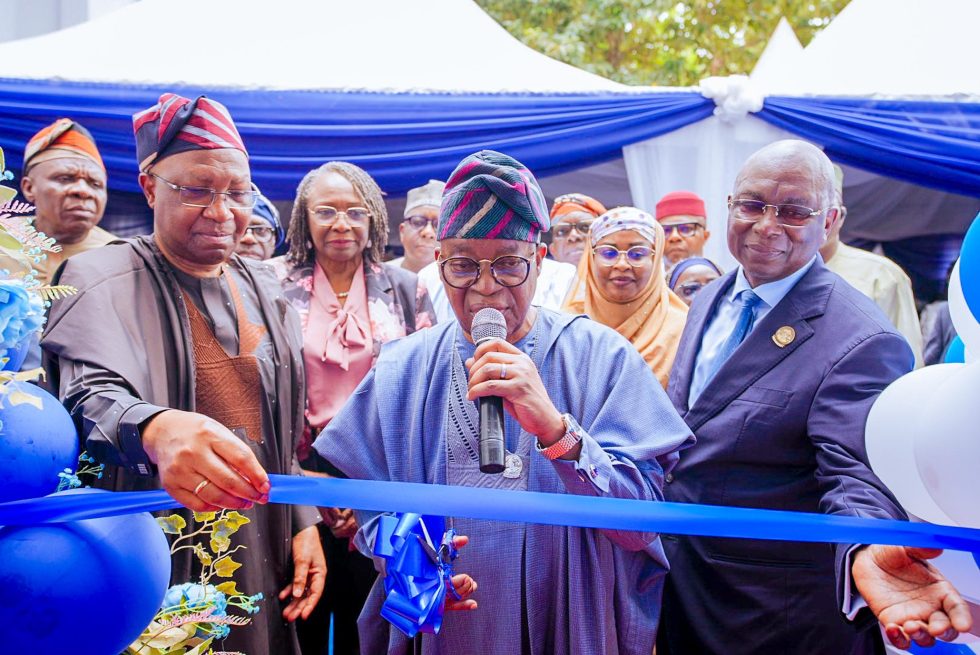
NIMASA donates building equipped with modern lecture rooms and laboratories to support teaching, research, and innovation in the maritime sector at the university of Lagos, reflecting the government’s commitment to prosperity in the blue economy.
By Blue Africa News
Prosperity in Nigeria’s blue economy will rely not just on natural resources but also on the strength of experts trained in academic institutions, minister of marine and blue economy Adegboyega Oyetola has said.
The minister emphasised the Federal Government’s focus on building institutional capacity to make the blue economy a pillar of Nigeria’s national prosperity.
“The future of the blue economy will be shaped not just by natural endowments, but by the quality of minds we nurture within institutions,” said the minister as quoted by orientalnewsng.com.
Speaking during the inauguration of a multipurpose building for the Institute of Maritime Studies (IMS) at the University of Lagos on April 16, 2026, Oyetola hailed the collaboration between the Nigerian Maritime Administration and Safety Agency (NIMASA) and the university, noting that it reflects the government’s commitment to knowledge-driven growth, especially in the blue economy.
Donated by NIMASA, the building is equipped with modern lecture rooms, laboratories and specialised facilities to support teaching, research, and innovation in the maritime sector.
Under the Nigerian Seafarers Development Program (NSDP), the minister said that over 2,400 Nigerians have received training in maritime institutions across the globe, including in the United Kingdom (UK), Egypt, the Philippines, India, and Romania, with 1,088 earning certificates of competency.
“In alignment with the national policy on marine and blue economy approved by the Federal Government last year which has placed priority on manpower training and development, I am pleased to note that 2,459 young Nigerians have so far been sponsored for training in reputable maritime institutions across the globe. Out of the number 1,088 have successfully obtained their certificates of competence, thereby contributing to the pool of skilled professionals required to drive the sector forward,” he added.
Dr. Dayo Mobereola, Director General of NIMASA on his part said the agency is partnering with like-minded academic institutions in Nigeria and abroad to strengthen manpower development in the blue economy, geared toward reducing dependence on foreign experts to drive the sector.
“As a maritime administration, we recognise that the true strength of any sector lies not only in its infrastructure and policies but in the quality, competence and preparedness of its capacity building,” said the DG.
He continued, “In this regard, the agency has consistently fostered strategic relationships with educational institutions including eight universities across Nigeria and two international institutions.”
The two international institutions include the World Maritime University (WMU) headquartered in Malmo, Sweden.
The new facility at the University of Lagos is expected to boost teaching, research and training in various areas, including but not limited to maritime law, shipping management, logistics, port operations and maritime environment.
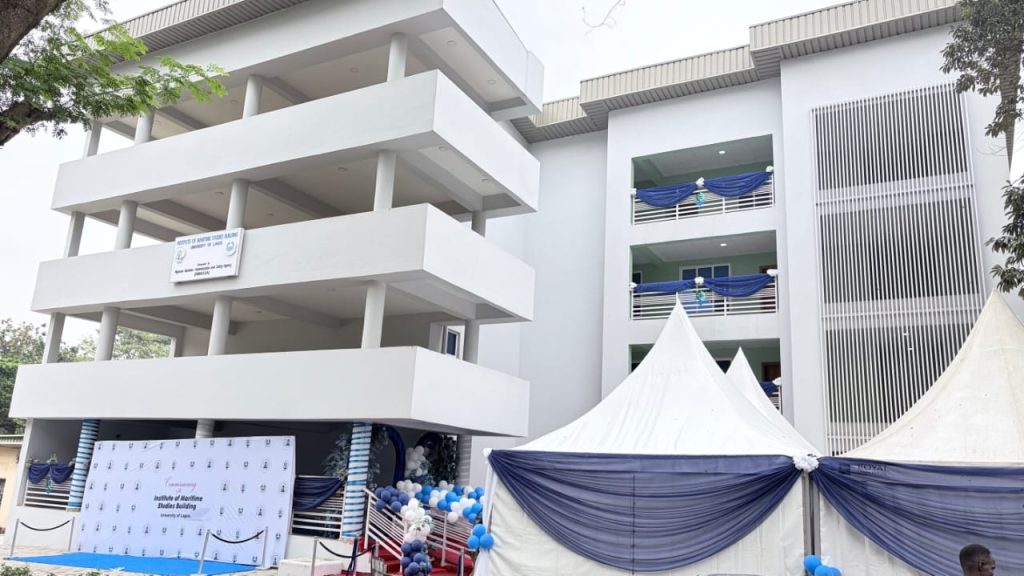
The Institute of Maritime Studies complex donated by the Nigerian Maritime Administration and Safety Agency, NIMASA to the University of Lagos. Photo courtesy: NIMASA
“The institute of maritime training University of Lagos was established in 2013 in response to the call by NIMASA for developing maritime manpower in the country and has evolved over time to offer solutions to the problems of the blue economy,” said Professor Folasade Ogunsola, University of Lagos Vice-Chancellor.
In February, NIMASA renewed its Memorandum of Understanding (MoU) with the World Maritime University, strengthening cooperation in maritime education, training and capacity development.
According to WMU, the renewed MoU establishes a framework for collaboration aimed at advancing Nigeria’s maritime interests, addressing the evolving needs of the maritime sector and supporting the sustainable development of the country’s maritime industry.
NIMASA remains a long-standing partner of WMU, with the agency sponsoring 72 officers to pursue education at WMU since 2018.
The renewed MoU runs for four years; 2026 – 2029. During the period, NIMASA will sponsor at least ten officers annually to pursue a Master of Science (MSc) in Maritime Affairs program in Malmo, with the training covering areas relevant to the agency’s work.
Oliver Ochieng, Blue Africa News